In case you needed yet another example of why a simple password can
come back to haunt you, a recently hacked Twitter account should have
you heading over to your account settings. Daniel Dennis Jones, who had
the Twitter handle @blanket ,
discovered that he was not able to access his account and realized that
his password had been changed. After digging into the issue further, he
found an alarming number of security flaws and lack of preventative
measures on Twitter’s end.
There’s a black market for Twitter handles, where commonly used names
are being sold for less than $100 or simply being handed out to friends
for what’s come to be known as the “lulz” — an Internet meme meaning
“just for laughs.” Turns out, this is exactly what Jones fell victim
to.
Jones’ entry into the world of Twitter jacking began on Saturday when
he was notified that his password had been changed. However, he was
still logged into Twitter on his phone and eventually was able to gain
access to his account via his email address only to realize that his
user name was changed to the very NSFW handle @FuckMyAssHoleLO.
Otherwise, nothing else on his account had been changed. After some
digging, Jones had discovered an underground network of young kids who
were jacking Twitter accounts with common (and short) names for pocket
change. @blanket, he found was selling for only $60.
Jones recounted his experience in Storify: “Twitternames that would have high value due to brevity: @hah, @captain, @craves, @abound, @grinding.”
The medium for selling cracked passwords that @blanket and other
hijacked accounts were being auctioned off was ironically through
Twitter, and also a forum called ForumKorner. If you visit the forum,
you’ll find anonymous individuals selling anything from jacked Minecraft
accounts to Twitter usernames.
So why is it so simple to crack Twitter passwords? First at fault
might be the user. Simple passwords that can be found in the dictionary
can be easily uncovered using the Brute Force Dictionary method. If
you’re using a password like “Zebra” for example, it’s only a matter of
time before the algorithm that rapidly inputs dictionary words to crack
an account eventually enters the correct password, “Zebra.” But in
Jones’ case, as he explained to Digital Trends, the password that he
used was not as easy to crack as you might expect. His was a combination
of a name and some numbers.
More notable is the way that Twitter built its security and account
input system makes it easy for anyone with the right program to hack the
account. What Jones discovered was that Twitter seeks to prevent a
large number of attempts that a single IP address attempts to access a
Twitter account. It’s a weaker system that makes it susceptible and
easier to hack. Most social networks will only offer a limited number of
attempts to access the account itself. What this means is that simply
by using multiple IP addresses, through a proxy for example, and an
algorithm that changes the IP address (before the CAPTCHA pops up), you
can attempt to breach an account for as many times as the number of IP
addresses that you’re using.
There’s an underground, albeit rudimentary, economy for stolen social
accounts that may not be at the forefront of our minds like identity
theft and the sales of social security IDs, but does in fact
thrive. Jones was briefly immersed in the world when he went so far as
to talk to a purported Twitter jacker,
who was just 14 years old, and explained to Jones that Twitter was
particularly easy to crack when compared to a site like YouTube.
He also learned that some of these kids are contracting hackers to
hijack specific accounts, whether to use for themselves or to “give to a
girl,” which was the reason that @blanket was targeted. ”These kids
decide they want a username and just sit there and wait for the jacker
to get it for them,” Jones explained. ”One kid I saw on Twitter, said it
took him 3 or 4 hours to crack a password for a username that he
wanted.”
If you’re using a vulnerable password, it’s really in your best
interest to change it fast. If you happen to get your account stolen
it’s unlikely that you’ll ever get it back, although Jones did get his
account reinstated but only likely after publicizing his experience.
source : digitaltrends
Tuesday, October 2, 2012

Monday, October 1, 2012
Illegal Downloaders in Japan Face Two Years in Prison
Under a new law that goes into effect Oct. 1, Japanese internet users
who illegally download files face a 2-year prison sentence or a fine of
up to 2 million yen ($25,700), the BBC reports.
Theoretically, pirating just one file could get you in jail and — under one interpretation — using a service such as YouTube, which temporarily stores video files on your computer, could be illegal.
Downloading copyrighted material has been illegal in Japan since 2010, but it did not incur such penalties. Uploading, on the other hand, is a far worse offense, with a maximum 10-year prison sentence and a 10 million yen ($128,400) fine attached.
The law was passed under influence of the Recording Industry Association of Japan, which cited a 2010 study, claiming illegal downloads in the country outnumber the legal ones ten to one.
Japan has been on the forefront of the anti-piracy fight in recent years. The Anti-Counterfeiting Trade Agreement (ACTA), a international treaty designed to protect intellectual property rights, was first created by the U.S. and Japan in 2006. The treaty was abandoned after a strong public movement against it in many countries, including the U.S., Hungary and Poland.
source : mashable
Theoretically, pirating just one file could get you in jail and — under one interpretation — using a service such as YouTube, which temporarily stores video files on your computer, could be illegal.
Downloading copyrighted material has been illegal in Japan since 2010, but it did not incur such penalties. Uploading, on the other hand, is a far worse offense, with a maximum 10-year prison sentence and a 10 million yen ($128,400) fine attached.
The law was passed under influence of the Recording Industry Association of Japan, which cited a 2010 study, claiming illegal downloads in the country outnumber the legal ones ten to one.
Japan has been on the forefront of the anti-piracy fight in recent years. The Anti-Counterfeiting Trade Agreement (ACTA), a international treaty designed to protect intellectual property rights, was first created by the U.S. and Japan in 2006. The treaty was abandoned after a strong public movement against it in many countries, including the U.S., Hungary and Poland.
source : mashable
Tuesday, September 25, 2012
When the Internet Finally Connected Itself to my Couch…
 |
| source : coolmaterial |
I’m old enough to remember when getting a TV with a remote control was a big deal. It used to be you needed to get up each time and change the channel by hand or yell at your kid to do it (that was me and my dad). Next came the wired remotes, which were better than nothing, but they got tangled in the cat (or the kid) all the time. When wireless remotes finally arrived, we knew we had made it because everything that mattered was now fully accessible from one’s indented spot on the couch. And things were very, very good.
Then the whole Internet thing happened and everything went downhill. Okay, I’m exaggerating, but it was really inconvenient. You’re watching a show and you want to know something about it. You have to get up and go to the computer in the other room, or worse yet, find where you put your smartphone. The whole world switched to the net and here I was stuck with a TV remote that only caught half of what mattered anymore. Something had to be done.
Well, it was. Say hello to the LG Smart TV with Google TV. Finally, the full buffet of the Internet and the absolute best of on-demand-TV have melded themselves together as one. LG’s Smart TV with Google TV actually links the web and the TV universe together like never before. And you can see it! In massive widescreen! In glorious HD – and even 3D, too!
No more squinting at tiny screens or going back and forth between computer and TV to find something. Just use your TV like always and access Facebook, Youtube, Netflix, Google Play, and many more apps. The mouse and keyboard are on LG’s magic remote, so you don’t have to leave your couch … ever! Order pizza, get a movie, pay a bill, take out a mortgage, whatever.
If being able to do all this while your butt is jammed on the couch isn’t proof of a bonafide technological revolution, then nothing is. You owe it to yourself to check out the latest innovations, starting with the LG Smart TV with Google TV first. I can promise, you won’t be disappointed.
Now where is that darn remote, anyway?!
source : coolmaterial
Saturday, September 22, 2012
Garage iPhone App
 |
| source : coolmaterial |
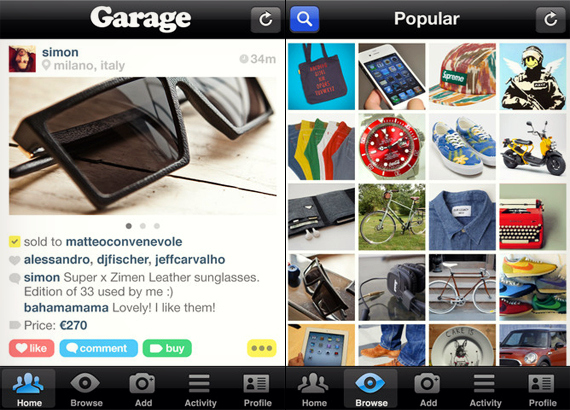
There are countless ways to sell things on the Internet. Etsy, eBay, Craigslist, forums, the list goes on and on. There are also countless ways to take pictures of things with your phone. Instagram, Camera+, Seed, and this list goes on and on as well. Garage takes the ability to sell shit you don’t need from the first list and combines it with the dead simple functionality of the second list. At the most basic level, Garage is Instagram with a buy button and Paypal integration. It does a lot more with the front end and the back end, but that’s really what it boils down to. A way to sell stuff on the Internet, using an interface you’re already familiar with, with nothing more than your iPhone. eBaygram, err Garage, is one of the coolest, easiest to use apps we’ve seen in a while.
source : coolmaterial
Polaroid Right Angle Spy Lens
 |
| source : coolmaterial |
Don’t you hate it when you’re trying to discreetly take a picture of some bombshell in a bikini only to have her turn and see you pointing a camera right at her? All of a sudden you’re the creepy one, right?? This lens from Polaroid will keep your dignity intact (questionable) and your perv levels at a minimum (also questionable). The Polaroid Right Angle Mirror Lens fits any lens with a 58mm filter thread (or 52mm with the included adapter) and lets you take pictures on a 90 degree angle (think the top of a periscope). Sure people will think you’re a blind dude with a camera, but the secretive shots you get will be worth it.
source : coolmaterial
Wednesday, September 19, 2012
Leica M Camera Sports a Full Framed Sensor
 |
| source : gadgetreview pic |
If you’ve got cash to burn, and you’re looking for a retro looking
camera body with a full frame sensor, than look no further than the new
Lieca M.
Replacing Leica’s old CCD sensor, is a completely brand
new and built from the ground up 24-megapixel CMOS sensor that is said
to provide the same great color reproduction as found in previous
iterations, yet uses less power and improves lower light capabilities.
Complementing that is Leica’s Maestro processor, which is also found in
their Leica S SLR cameras.
True photogs will have to invest in a
viewfinder, otherwise you’ll be stuck with the 3-inch 920,000 dot
display, which mind you is covered in Gorilla Glass for added
durability. Leica also says the body of the camera is splash proof, not
to mention extremely tough thanks to the full-metal body that is
manufactured from one piece from high-strength magnesium alloy.
Other
features include an ISO of 6400, full HD video capture mode, an
“extremely long battery life”, multi-pattern and spot exposure metering,
and a whole bunch more stuff.
The all new Leica M will hit retail shelves sometime in the beginning of 2013 with a price tag of about $7,000.
source : gadgetreview
Motorola’s Razr i: A Razr M With Intel Inside
 |
| source : wired picture |
Motorola and Intel’s plan to build Android phones with Intel processors is finally coming to fruition. Things got off to a slow start back in April when Intel attempted to build a handset on its own, producing the dull, low-end AZ210. The device, which launched in India, Russia and the United Kingdom, garnered an almost unanimous “meh.”
On Tuesday, Motorola announced an Intel-powered phone of its own that
looks like it will be the complete opposite of the AZ210. The Razr i,
as it will be called, is essentially a Razr M with a powerful new Intel 2GHz CPU packed inside.
Everything that made the Razr M so compelling carries over to the
Razr i, including 1GB of RAM, 8GB of on-board storage, a microSD card
slot for expanded storage, a 4.3-inch display that runs to the edges of
the handset, and the Razr line’s signature Kevlar back. Like the Razr M,
the Razr i features an 8-megapixel camera that can shoot up to 1080p
video. Unfortunately, the Razr i also has the same PenTile display with a
low 960×540 resolution.
On thing that isn’t clear at this point is whether the phone will
ever see a U.S. release. The Razr line of Android phones, including the
Razr M, has so far been exclusive to Verizon in the U.S. On Tuesday,
Motorola said in a statement
that the Razr i would launch in October in “select European and Latin
American markets including the U.K., France, Germany, Argentina, Brazil
and Mexico, with more to be announced.”
So far, no Intel-powered Androids have launched in the U.S. But given Intel’s stated plans, we wouldn’t expect that to last indefinitely.
source : wired
Subscribe to:
Comments (Atom)